The honest answer is "fewer than you think, but not as few as people say". Slide count matters less than what's on each slide. Still, you need a number to plan with, so here's the one we use.
Short on time? Our free slide count calculator gives you a slide range, time per slide and an outline for your type of talk.
- Start with about one slide per minute.
- Count ideas, not slides: one idea per slide.
- Split crowded slides instead of cutting content.
In this guide
01The starting rule: about one slide per minute
For a normal talk, one slide per minute is a sensible default. You'll spend longer on a dense chart and a few seconds on a section divider, and it averages out.
| Talk length | Slides | Notes |
|---|---|---|
| 5 minutes | 5 to 7 | One idea each, no agenda slide needed |
| 10 minutes | 8 to 12 | A quick agenda helps |
| 20 minutes | 15 to 25 | Use section dividers |
| 30 minutes | 20 to 35 | Plan one interactive moment in the middle |
| 60 minutes | 35 to 60 | Break into clear chapters |
02By presentation type
01Pitch deck
10 to 15 slides for the version you send or present in a first meeting. Investors read fast, so every slide has to earn its place. Put detailed financials and extra data in an appendix. Our pitch deck structure guide lists the slides.
02Class or university presentation
Follow the time limit, then use the table above. Graders usually care about structure more than count, so make sure you have a clear intro, sections and a summary. See how presentations are graded.
03Company profile or sales deck
10 to 20 slides. The person reading it may not be the person deciding, so it has to make sense without you talking over it.
04Webinar
More slides than you'd expect. People watching online drift off if a slide sits still for too long, so change something on screen every 30 to 60 seconds.
03When more slides is actually better
A slide with eight bullet points can almost always become four slides with two points each. Your talk takes the same time, but the room only has to read one thing at a time. Splitting content is the single easiest way to make a deck feel lighter.
1 slide: 8 bullet points about our results
4 slides: one result each, with a number and a photo

04When fewer is better
Decks that get emailed instead of presented should be shorter and a bit denser, because nobody is there to explain. The same goes for board meetings, where people expect a tight summary and an appendix.
Count ideas, not slides. One idea per slide, and the number takes care of itself.
05A quick check
- Time yourself going through the deck out loud once.
- Find the slides you rushed. They're probably too full. Split them.
- Find the slides you skipped. They probably don't need to exist.

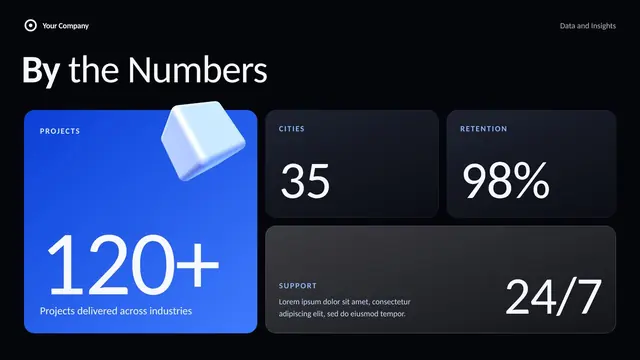

Every template has 50 layouts, so you can pick the ones your talk needs and delete the rest.
06FAQ
How many slides for a 10-minute presentation?
Usually 8 to 12. Around one slide per minute is a good starting point, then adjust for how much you talk on each one.
How many slides for a 20-minute presentation?
Roughly 15 to 25. Fast-moving slides with one image or number can push it higher without feeling long.
How many slides should a pitch deck have?
Most first-meeting pitch decks land between 10 and 15 slides, with extra detail in an appendix.
Is it bad to have too many slides?
Not by itself. Forty slides with one idea each can feel quicker than ten slides packed with text. What matters is how long you stay on each one and how much is on it.
Written by MEGGYSTUDIOWe design 50-slide PowerPoint templates with Morph built in.